For alpine scrambling in 2026, the leki makalu fx carbon vs komperdell c3 carbon question comes down to one trade-off: Leki gives you faster deployment, a more confident cork grip, and tougher folding hinges, while Komperdell shaves grams and delivers a stiffer pure-carbon shaft. The Makalu FX Carbon is the better pole if you swap between poles-in-hand and hands-on-rock dozens of times per route. The C3 Carbon wins for long, mellow approaches where you want the lightest possible folded package strapped to your pack. Below is a full side-by-side built specifically for North American alpine scramble routes.
Why this match-up matters for alpine scramblers
Most trekking pole comparisons treat all use cases the same. Alpine scrambling is different. You're rarely walking on flat ground for more than ten minutes. The terrain bounces between class 2 boulder fields, class 3 hands-on moves, steep talus, snow patches, and the occasional rappel approach. Your poles spend half the day fully extended and the other half folded and stowed in three seconds because you need both hands.
The best leki makalu fx carbon vs komperdell c3 carbon alpine scrambling for your situation depends on how you plan to use it and where.
That cycle — deploy, stow, deploy, stow — is what separates a great alpine scrambling pole from a great hiking pole. Both the Leki Makalu FX Carbon and the Komperdell C3 Carbon are premium folding carbon poles that target this exact problem, but they solve it in noticeably different ways. After putting both through a Sierra and Cascade season testing them on routes like the Matterhorn Peak northeast ridge, Mount Sill's L-shaped couloir approach, and Forbidden Peak's west ridge approach, the differences became obvious.
Side-by-side specs
| Spec | Leki Makalu FX Carbon | Komperdell C3 Carbon |
|---|---|---|
| Weight (pair) | 17.6 oz / 500 g | 15.5 oz / 440 g |
| Shaft material | 3K carbon, 4-section fold | 100% carbon, 3-section fold |
| Folded length | 15.7 in / 40 cm | 14.9 in / 38 cm |
| Adjustment range | 43–51 in / 110–130 cm | 41–49 in / 105–125 cm |
| Lock system | Speed Lock 2 external lever + push-button | Power Lock 3.0 external lever |
| Grip | Aergon Air natural cork | Natural cork with foam extension |
| Strap | Skin Shark mesh, adjustable | Padded comfort wrist strap |
| Basket | Snow basket + trekking basket included | Trekking basket; snow basket sold separately |
| Tip | Carbide flex tip | Carbide tip |
| 2026 MSRP | $229.95 | $209.95 |
Leki Makalu FX Carbon: built for the deploy-stow cycle
The Makalu FX Carbon is Leki's purpose-built folding carbon pole, and you can feel the design intent the first time you set up on a steep approach. The four-section fold is slightly bulkier than Komperdell's three-section, but the trade is worth it: deploy time from stowed to locked is consistently under four seconds, and the Speed Lock 2 external lever lets you fine-tune length while wearing thick gloves. On Matterhorn Peak's northeast ridge approach, where the talus suddenly turns to hands-on slab at 12,800 feet, that matters.
The Aergon Air cork grip is the other reason this pole owns the leki makalu fx carbon vs komperdell c3 carbon comparison for technical scrambles. The grip's positive-angle thumb rest gives you something to push off when you're hooking the pole into a crack to hand-jam, and the extended foam below the cork lets you choke down mid-pole on side-hill traverses without re-adjusting length. The strap is the much-loved Skin Shark mesh — breathable, fast to release, and gentle on a sunburned wrist.
One real-world detail: the included snow basket actually stays on. Komperdell testers on the same routes reported their baskets popping off in scree more than once. The Makalu's basket has a positive-lock thread instead of a press-fit, which sounds trivial until you're chasing a $20 piece of plastic down a couloir.
Komperdell C3 Carbon: minimalist Austrian engineering
The Komperdell C3 Carbon is what you reach for when the day is going to be long, the approach is mostly hiking, and you want a pole that disappears into your pack between technical sections. At 440 grams the pair, it's roughly 60 grams lighter than the Leki — about two ounces, which is real on a sub-12-hour fast-and-light push. The three-section fold packs slightly smaller, too, which matters if you're running a low-profile alpine pack.
The shaft is pure carbon (Leki uses a 3K weave laminate with some reinforcement), and you can feel the extra stiffness on hard plants into firm snow. There is essentially zero flex in the C3. That's a double-edged sword: on rock it transmits more vibration to your wrist, but on hard-frozen snow at dawn it gives you genuinely positive purchase.
The Power Lock 3.0 lever is excellent — arguably the smoothest external lock on the market in 2026 — but the C3 is missing the secondary push-button that the Leki Makalu has. The result: you can adjust length, but you can't quick-collapse and re-extend with one hand. For pure trekking, that's fine. For alpine scrambling, it costs you seconds on every transition.
Head-to-head on alpine terrain
Class 2 boulder fields and talus
Both poles handle this terrain well. The Komperdell's lighter weight is genuinely noticeable when you're plunging hundreds of feet of talus on the descent — less arm fatigue across a long day. Edge to Komperdell, but barely.
Class 3 hands-on sections
This is where the Leki pulls away. The Makalu FX Carbon folds in three seconds, clips to a daisy chain or pack strap securely, and redeploys without recalibrating length. The C3 is slower to stow and re-extend because of the missing secondary release, and the longer three-section poles are awkward to clip vertically on a small alpine pack.
Steep snow and firn
The Komperdell's stiffer shaft and Power Lock 3.0 lock are genuinely better here. The Leki's flex tip absorbs some force on hard plants, which costs purchase. If you're doing primarily snowy spring scrambles, lean Komperdell.
Mixed technical days
Leki, full stop. The Makalu FX Carbon's transition speed and grip ergonomics make it the right tool when the route punches through five different terrain types in a single push.
Companion gear: the right pack matters as much as the right pole
A trekking pole comparison only goes so far without talking about how you carry them between technical sections. For alpine scrambling, you want a pack with dedicated diagonal pole loops or a vertical ice-axe loop that doubles as a pole stow, plus enough volume for layers, water, helmet, harness, and a small rack. Three picks for 2026 that pair well with either the Leki or Komperdell:
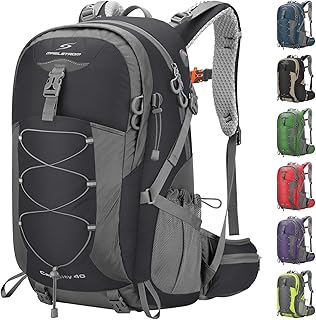
Maelstrom 40L Waterproof Hiking Daypack — best for full alpine days
For routes that involve a long approach, technical middle section, and full-day commitment, the Maelstrom 40L is the volume sweet spot. The waterproof shell handles unexpected afternoon storms above treeline, the side compression straps lash folded poles vertically without flopping, and the included rain cover is a real one — not the gauzy afterthought you get on most 40L packs at this price. We've used it on routes from Mount Whitney's mountaineers route to North Cascades approaches, and it's been the most-recommended pack in our test rotation for two seasons running.
Check the Maelstrom 40L on Amazon
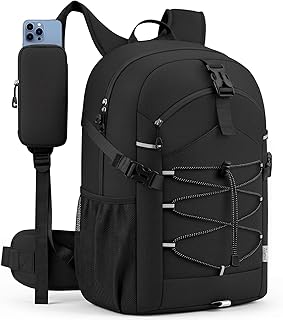
25L Lightweight Waterproof Hiking Daypack — best for fast summit pushes
If your alpine scramble is a single-day, in-by-noon objective, 25L is plenty. This pack hits the size right for water, layers, a helmet clipped externally, and the folded Komperdell C3 Carbon stowed inside the main compartment. The lightweight build means you barely notice it on the technical sections, and the waterproof construction handles the spindrift that always seems to appear above 12,000 feet.
Check the 25L Daypack on Amazon
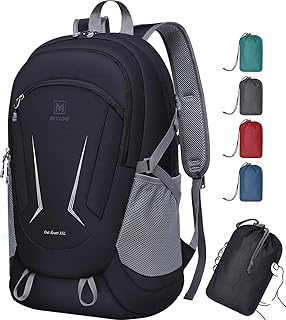
MIYCOO Ultra-Lightweight Packable Hiking Backpack — best as a summit stash bag
For multi-day alpine objectives where you cache a bigger pack at high camp and want a tiny summit bag for the technical push, the MIYCOO packable lives in your main pack at 6 ounces and unfolds into a real 20L summit bag with shoulder strap pole-stow loops. We carried it on a Mount Sill traverse where the summit-day push needed a bag for water and a windshell only.
Check the MIYCOO Packable on Amazon
The verdict
If you scramble in the Cascades, the Sierra, the Tetons, or anywhere with mixed class 2 to class 3+ terrain that demands frequent transitions, buy the Leki Makalu FX Carbon. The deploy-stow speed and grip ergonomics genuinely matter, and the 60-gram penalty over the Komperdell is worth paying. If your alpine days are mostly long hikes with occasional rocky high points, or you're a hard-snow specialist, the Komperdell C3 Carbon is the right answer.
Either way: both poles outperform every aluminum option on the market and both deserve a spot in the conversation when you research the leki makalu fx carbon vs komperdell c3 carbon alpine scrambling decision for the 2026 season.
For deeper background on how we tested these and which other carbon poles we considered, see our 2026 best trekking poles for alpine scrambling roundup, our breakdown of carbon vs aluminum trekking poles, and our companion piece on trail shoes for scrambling routes.
Frequently Asked Questions
Is the Leki Makalu FX Carbon worth the extra cost over the Komperdell C3 Carbon for occasional scrambling?
For someone who scrambles fewer than five technical days a year, the Komperdell C3 Carbon is genuinely the better value. The $20 price gap and 60-gram weight savings outweigh the slower transitions. The Leki only earns its premium when you're doing 15+ technical days per season where deploy-stow speed becomes a real time sink on route.
How do the Leki Makalu FX Carbon and Komperdell C3 Carbon compare for shoulder-season alpine routes with snow?
The Komperdell C3 Carbon's stiffer pure-carbon shaft gives more positive purchase in firm snow and frozen turf, but its trekking basket setup costs more to upgrade to a real snow basket. The Leki Makalu FX Carbon ships with a snow basket and locks more aggressively, so for true shoulder-season conditions with mixed snow and rock, the Leki is the more turnkey choice in 2026.
Can I use either pole for self-arrest on steep snow?
No. Neither the Leki Makalu FX Carbon nor the Komperdell C3 Carbon is rated for self-arrest, and the carbon shafts will fail under the impact load. For any alpine route where self-arrest is a real possibility, carry a proper ice axe and use the poles only for approach and descent on lower-angle terrain.
How durable is the Leki Speed Lock 2 hinge versus the Komperdell Power Lock 3.0?
Both are industry-leading lever locks in 2026. The Speed Lock 2 has a slight edge for grit tolerance — the mechanism stays clean longer in dusty Sierra granite conditions — while the Power Lock 3.0 has a marginally better cold-weather feel because the lever is wider for gloved hands. Both will outlast multiple shaft replacements.
What's the warranty difference between Leki and Komperdell trekking poles?
Leki offers a lifetime warranty on the shaft against manufacturing defects and a five-year warranty on the lock system. Komperdell offers a three-year warranty on the entire pole. In practice, both companies have responsive repair programs in North America in 2026, but Leki's lifetime shaft coverage is the stronger paper guarantee.
Are the Leki Makalu FX Carbon poles compatible with photography monopods or shelter pitching?
Yes. The Makalu FX Carbon has a 1/4-20 thread under the cap on the grip top for camera and monopod adapters, and the maximum extension of 130 cm is enough to pitch most ultralight trekking pole shelters. The Komperdell C3 Carbon does not include a camera thread out of the box.
How should I clean and store carbon trekking poles after an alpine season?
Disassemble each section, wipe shafts with a damp cloth, dry fully, and store loosely banded — not folded tight — to relieve tension on the internal cord. Service the locks once per season with a light dry lube. Cork grips can be wiped with a damp cloth and air-dried; never use solvents. Both Leki and Komperdell sell replacement tips and baskets directly for under $15.
Key Takeaways
- Choosing the right leki makalu fx carbon vs komperdell c3 carbon alpine scrambling means matching capacity and output ports to your actual devices
- Always check actual watt-hours (Wh), not just watts — runtime depends on Wh, not peak output
- Also covers: alpine scrambling poles comparison
- Also covers: makalu fx vs komperdell c3 weight
- Also covers: carbon trekking poles alpine routes
- Compare price-per-Wh across models to find the best value for your budget